Introduction
Air fryers have become one of those appliances that most households either own or are actively considering. The category earned its place not through novelty but through a genuine cooking benefit — faster, crispier results with significantly less oil than deep frying, in a countertop package that doesn’t require heating a full-size oven for a modest quantity of food. That core proposition hasn’t changed since the category took off, but what has changed considerably is the range of what individual models can do beyond that core function.
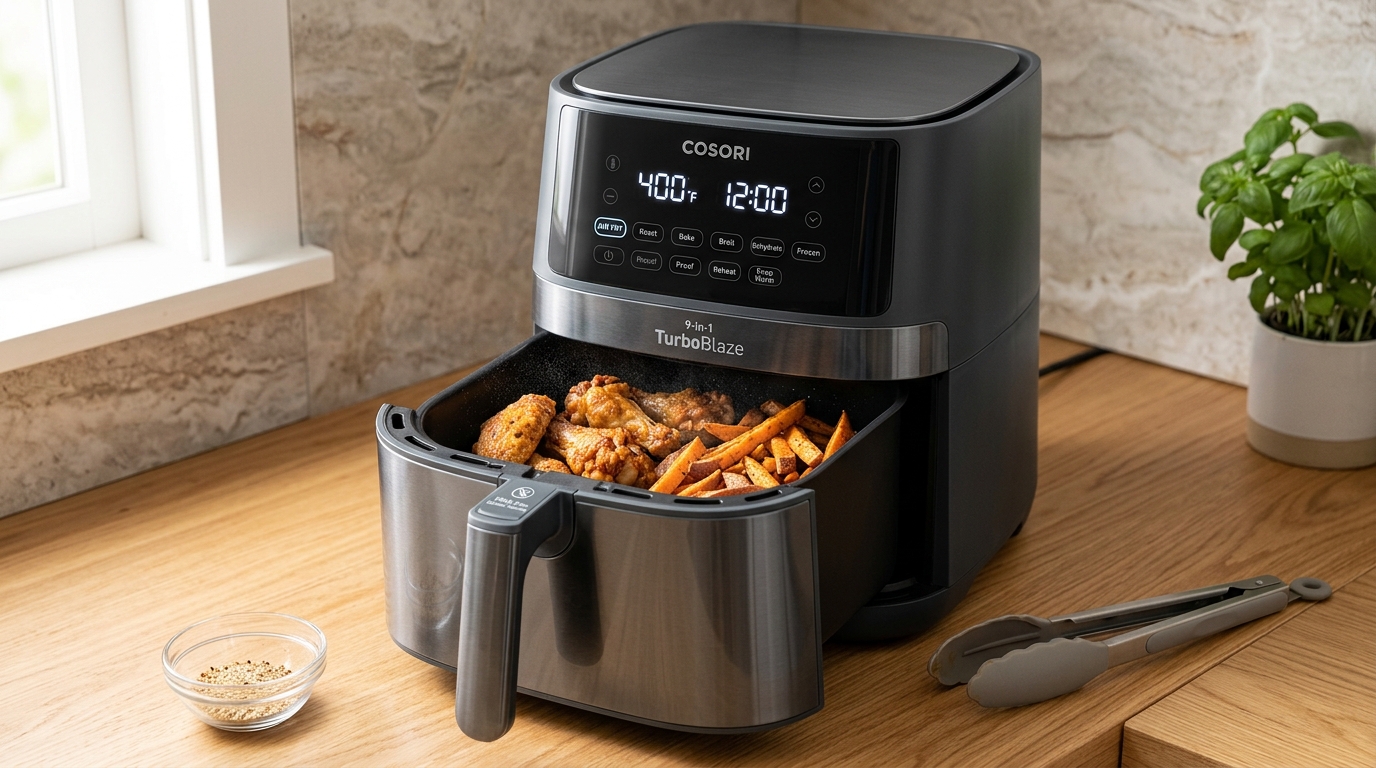
The COSORI TurboBlaze 9-in-1 represents where the category has arrived after years of development. Nine distinct cooking functions. A temperature range that runs from 90°F to 450°F — a 360-degree span that makes each of those nine functions genuinely different from the others rather than variations on a single theme. A PFAS-free ceramic coating that addresses a health and materials concern that many households have been navigating across their cookware purchases. And TurboBlaze airflow technology designed to address one of the most persistent limitations of standard air fryer design — uneven heat distribution across the cooking basket.
This is the fourth time this article has been written, which means the approach here is deliberately fresh — not covering the same ground the same way, but finding the angles that matter most when making a real purchasing decision about a real kitchen appliance.
The Core Question: What Makes Nine Functions Genuinely Different?
Most multi-function appliances claim a number of functions that, when examined honestly, turn out to be variations on one or two actual cooking approaches with slightly adjusted timer settings. Understanding why the TurboBlaze’s nine functions are meaningfully distinct requires starting with the temperature range — because that range is what makes genuine differentiation possible.
At 90°F, the TurboBlaze is operating at a temperature appropriate for yeast fermentation — warm enough to activate and sustain yeast activity, cool enough not to kill it. At 450°F, it’s producing intense surface heat appropriate for maximum-crispness applications and broiling. Nothing in between those two extremes is the same cooking environment, and each of the nine preset functions lives in a specific region of that range calibrated for a specific cooking purpose.
Proof at the low end uses 90°F range temperatures to create a consistently warm environment for bread dough, pizza dough, cinnamon rolls, or any yeasted preparation that needs to rise reliably. Home kitchens vary enormously in ambient temperature — cold in winter, drafty year-round, inconsistently warm in ways that make yeast proofing unpredictable without a controlled environment. The Proof function provides that controlled environment automatically, which is something no air fryer operating from 180°F upward can offer.
Dry uses sustained low-to-moderate temperatures over extended periods for dehydration — removing moisture from food without cooking it in the conventional sense. Beef jerky. Fruit chips. Dried herbs. Vegetable crisps. These require hours at temperatures that standard air fryers running from 180°F often can’t calibrate precisely enough for genuine dehydration without cooking the food rather than drying it.
Frozen handles the specific challenge of food going directly from freezer to basket — adjusting for the temperature deficit of starting from frozen rather than room temperature, producing results more consistently appropriate than manually adapting the Air Fry function to account for frozen starting conditions.
Air Fry handles the core function that defines the category — rapid hot air circulation producing crisped, browned results with minimal oil. Chicken wings, fries, fish fillets, roasted vegetables, breaded proteins — this is the everyday workhorse function.
Roast calibrates for denser proteins and vegetables that need to cook through at controlled temperatures before exterior browning becomes the priority. Different timing and temperature curves from Air Fry produce more evenly cooked-through results for items like whole chicken thighs, pork tenderloin, and root vegetables.
Bake uses the cooking chamber as a small oven for appropriately sized baked goods — muffins, cookies, small cakes, brownies in air fryer-compatible pans. Six muffins don’t require preheating a full-size oven.
Broil at the high end of the temperature range applies intense heat for surface finishing — browning cheese, charring a glaze, finishing the top of a gratin. Tasks that take two to four minutes under a proper heat source without the overhead of running a full oven.
Reheat brings leftovers back to temperature with restored texture rather than the steamed softness that microwave reheating reliably produces for anything with a crispy component.
Keep Warm holds finished food at safe serving temperature when meal components finish at different times.
Nine functions that are each genuinely calibrated for specific purposes, across a temperature range broad enough to make them distinct from each other. That’s what separates the TurboBlaze’s nine functions from a marketing number.
The PFAS-Free Ceramic Coating: Understanding What It Means
The PFAS conversation has moved significantly in recent years from a niche environmental health discussion into mainstream consumer awareness, and it’s worth understanding specifically what the TurboBlaze’s ceramic coating offers and why it matters for an air fryer specifically.
PFAS — per- and polyfluoroalkyl substances — are a class of synthetic compounds used in the fluoropolymer-based non-stick coatings that cover the vast majority of non-stick cookware and small appliance cooking surfaces. The concerns around PFAS compounds relate to their persistence in the environment, their accumulation in human tissue, and questions about their behavior at elevated temperatures — specifically whether heat causes the coating to release compounds into food or cooking environment.
For an air fryer, the temperature consideration is particularly relevant. Air fryers routinely operate at 375°F to 400°F for extended cooking sessions — temperatures that are within the range where various researchers have raised concerns about PTFE-based coating behavior. At 450°F with the TurboBlaze’s MaxCrisp-equivalent settings, the temperature exceeds what many PTFE coating manufacturers recommend for extended use.
The TurboBlaze’s ceramic coating addresses this through a fundamentally different material chemistry. Ceramic non-stick coatings use inorganic mineral compounds — silicon dioxide-based materials — that achieve food release properties without fluoropolymer chemistry. No PFAS compounds in the coating, no concerns about their release at elevated temperatures, and a material that’s considered chemically inert across the temperature range the TurboBlaze operates at.
In everyday cooking terms, ceramic non-stick performs comparably to PTFE non-stick for the vast majority of applications. Food releases cleanly, the surface cleans easily with a soft sponge and mild soap, and the cooking outcomes are equivalent for everything from air-fried chicken to roasted vegetables to baked goods.
The care distinction is real and worth understanding clearly: ceramic coatings are more vulnerable to scratching from metal utensils than PTFE coatings, and abrasive cleaning tools damage the ceramic finish more readily. Silicone or wooden utensils inside the basket, soft sponge cleaning rather than abrasive pads, and hand washing rather than dishwasher cycles — these care practices, applied consistently from first use, maintain the ceramic coating’s performance through years of regular cooking.
TurboBlaze Airflow: The Heat Distribution Problem and the Solution
Standard air fryer design positions a heating element and fan in a fixed location relative to the cooking basket, typically above the basket with airflow directed downward. The limitation of this configuration is physics — air traveling from a fixed point doesn’t distribute itself evenly across the entire basket volume. Areas directly in the airflow path receive more heat. Areas at the periphery receive less. The result is food that browns unevenly across a batch, with pieces near the center cooking faster than those at the edges.
Home cooks compensate for this limitation through mid-cook basket shaking — the near-universal recommendation in air fryer recipes to shake the basket halfway through cooking to redistribute food and expose different surfaces to the more direct airflow. Shaking works, but it’s an active intervention that compensates for a design limitation rather than solving it.
TurboBlaze technology represents COSORI’s engineering approach to reducing this uneven distribution problem through a redesigned airflow architecture that circulates heat more comprehensively throughout the cooking chamber. The specific implementation — the positioning and design of the heating element relative to the fan and the basket geometry — distributes hot air more evenly throughout the 6-quart cooking space.
The practical outcome is more consistent browning across a full basket of food without the degree of mid-cook intervention that compensates for standard designs. A tray of chicken wings coming out of the TurboBlaze shows more uniform browning across all pieces simultaneously than the same wings in a standard air fryer with fixed-point airflow would produce.
This matters most in exactly the cooking scenarios where air fryers are used most heavily — full-basket loads for family-sized portions, where the uneven distribution of standard designs shows most clearly in the inconsistent results across the batch.
Key Features of the COSORI TurboBlaze
6-Quart Capacity
Six quarts positions the TurboBlaze in the larger end of the standard single-basket format. For households of three to five people, this capacity handles most everyday air frying in a single load — enough chicken thighs for a family dinner, a generous quantity of vegetables for four people, a full batch of wings without the overcrowding that smaller baskets impose when cooking comparable quantities.
The relationship between capacity and heat distribution is worth noting: TurboBlaze airflow is engineered for the 6-quart cooking chamber specifically. The heat distribution improvements are calibrated for this basket size, which means a full basket in the TurboBlaze produces the intended results rather than requiring the basket to be partially filled to achieve even cooking.
Digital Touch Interface
The touch panel provides function selection, temperature adjustment, and timing control through a clearly organized interface. Function buttons are distinctly labeled for each of the nine programs, temperature and time adjustments are intuitive, and the display gives clear feedback on current settings and remaining cook time throughout a cooking cycle.
The interface is accessible from first use without a learning curve for basic functions. Understanding which function works best for specific foods — the nuanced judgment that comes from using the appliance regularly — develops through experience, but operating the interface itself requires essentially no instruction beyond identifying the appropriate function button.
Dark Gray Finish
The dark gray exterior is a deliberate aesthetic choice that works in most kitchen environments without demanding visual attention. Dark finishes handle the combination of steam, cooking vapors, and regular handling that air fryers experience better than lighter finishes in terms of visible maintenance between cleanings. The TurboBlaze’s appearance on the counter is professional and understated — appropriate for an appliance that earns its space through daily use rather than visual impact.
How the TurboBlaze Works in Real Cooking Situations
The Everyday Air Frying Core
The Air Fry function handles the daily workload — the proteins, vegetables, and frozen foods that make up the majority of air fryer use in most households. Chicken pieces develop properly crisped skin. Fish fillets brown on the exterior while remaining moist inside. Frozen fries come out with genuine crunch rather than the pale, soft results that oven preparation produces. Broccoli and Brussels sprouts develop caramelized edges in 12 to 15 minutes.
The TurboBlaze’s even heat distribution contributes most noticeably here in full-basket situations. A complete family dinner’s worth of chicken thighs, spread across the basket, develops consistent browning across all pieces — the rear of the basket performing comparably to the front, the edges performing comparably to the center.
Bread Proofing That Actually Works
The Proof function deserves specific attention because it represents a capability that changes what’s practically achievable for home bakers who have dealt with inconsistent results from room-temperature proofing.
The scenario is familiar to anyone who bakes yeasted bread at home: you make dough, shape it, and leave it to rise. In a warm kitchen in August, it rises quickly and perhaps too fast. In a cool kitchen in January, it rises slowly and perhaps never reaches full proof before you give up and bake an underdeveloped loaf. The Proof function removes ambient temperature from the equation by creating a consistent warm environment in the sealed basket, producing predictable, reliable rises regardless of season or kitchen conditions.
For households that bake bread, pizza dough, or cinnamon rolls regularly, this represents a meaningful practical improvement in results consistency — not just convenience, but better bread because the fermentation environment is controlled rather than subject to whatever the kitchen happens to be that day.
Broiling Without the Oven
The Broil function at 450°F handles the quick, high-heat surface finishing tasks that feel disproportionate to accomplish by turning on the full oven broiler. Finishing one or two portions of salmon with a charred surface. Melting and browning the cheese top of individual-serve gratins. Caramelizing a sugar or glaze coating on roasted carrots. These tasks take two to four minutes at high heat — time that’s well spent in the TurboBlaze without the full oven preheat and energy expenditure of running an oven broiler for such brief cooking.
Homemade Dehydrated Snacks
The Dry function’s value becomes clearest for households that regularly purchase jerky, dried fruit chips, or similar snacks and want the cost savings and ingredient control of home production. Beef strips marinated to personal taste specifications, sliced apples or mangoes, kale chips seasoned as preferred — all of these dehydrate through the Dry function over several hours at temperatures low enough to remove moisture without conventional cooking.
The math of commercial jerky versus homemade jerky in the TurboBlaze is straightforward for regular consumers: a single appliance cycle of homemade jerky costs a fraction of the equivalent quantity of commercial product. Over a year of regular production, the appliance investment is easily recouped.
Reheating That Doesn’t Disappoint
The Reheat function consistently surprises people who have accepted microwave reheating as the only practical option for leftover food. Pizza reheated in the TurboBlaze for three to four minutes returns with a crisp base — not the soft, sometimes rubbery result of microwave reheating. Leftover fried chicken develops close-to-original crunch. Pastries return to something genuinely close to fresh-baked texture.
For households where leftovers are a regular part of the weekly eating pattern, this quality difference accumulates into a meaningfully better food experience across multiple meals per week. The reheat function doesn’t transform leftovers into something better than the original — but it doesn’t diminish them the way a microwave consistently does.
Who Benefits Most from the TurboBlaze
Households That Have Already Moved Away from PTFE Cookware
For kitchens that have systematically replaced PTFE-coated frying pans, baking sheets, and other cookware with ceramic, stainless, or cast iron alternatives, a PTFE-coated air fryer basket represents an inconsistency in an otherwise PFAS-conscious kitchen. The TurboBlaze’s ceramic coating aligns with that purchasing approach — one less fluoropolymer surface in a kitchen that has been moving away from them.
Home Bakers Who Want More Flexibility
The combination of the Proof function at the low temperature end and the Bake function for small-batch baking creates meaningful additional capability for households that bake regularly. Proofing dough and baking the finished product in the same appliance — managing both stages of the bread-making process without the oven — suits the household that bakes frequently in modest quantities rather than large batches.
Households That Entertain With Food
For cooking for groups — hosting dinner parties, preparing snacks for gatherings, making food for family events — the TurboBlaze’s capacity and heat distribution improvements contribute to cooking larger quantities more consistently. A full basket of appetizers where every piece is properly done simultaneously makes a more favorable impression than a batch with inconsistent browning across pieces.
People Who Have Found Other Air Fryers Limiting
Households that have used a basic three or four-function air fryer and found themselves consistently wishing for capabilities it doesn’t offer — specifically, the ability to dehydrate, proof bread, or broil without the oven — will find the TurboBlaze’s nine functions address those specific gaps. The upgrade is most meaningful when the missing functions correspond to things you actually cook rather than theoretical additions that sound useful but don’t match real cooking habits.
What Requires Honest Consideration
Ceramic Coating Care Is Non-Negotiable for Long-Term Performance
The PFAS-free ceramic coating’s performance advantage is real, but so is its care requirement. Metal utensils in the basket scratch ceramic surfaces more readily than PTFE coatings absorb the same scratching. Dishwasher cycles degrade ceramic surfaces faster than hand washing. Abrasive cleaning pads damage the finish noticeably. These aren’t excessive requirements — they’re standard care for ceramic cookware — but they require consistent application from first use rather than treating the basket with the casual durability assumption that some non-stick coatings allow.
Households that have a track record of treating non-stick surfaces carelessly — reaching in with metal tongs, throwing pans in the dishwasher, scrubbing aggressively — should factor in whether the ceramic coating’s care requirements fit realistically with their kitchen habits.
Nine Functions Require Investment in Learning
Genuinely getting value from nine distinct cooking functions means understanding which function produces the best results for which foods — judgment that develops through use rather than being immediately obvious from reading a manual. During the first several weeks of ownership, some function selection will be intuitive (Air Fry for wings, Reheat for leftover pizza) while others will require experimentation (understanding the difference between Roast and Air Fry outcomes for specific proteins, calibrating Dry function time for different jerky thicknesses).
This is a minor consideration rather than a significant limitation, but it means the TurboBlaze’s full value isn’t immediately accessible from day one — it develops as cooking habits and function familiarity build together.
Baking Scale Has Clear Limits
The 6-quart basket accommodates small baking accessories appropriately — 7-inch round pans, silicone molds sized for the basket, individual ramekins, small loaf pans. Standard full-size baking equipment doesn’t fit. For households that bake in large quantities or rely on standard pan sizes, the oven remains necessary for those applications. The TurboBlaze’s Bake function serves small-batch convenience baking rather than replacing a full baking setup.
Counter Real Estate Is Genuinely Required
A 6-quart air fryer is not a compact appliance. The TurboBlaze requires dedicated counter space and overhead clearance for the basket to open and operate properly. In kitchens where counter space is genuinely scarce, the footprint commitment is a real consideration — not something that can be solved by storing the appliance in a cabinet and pulling it out when needed, because the overhead clearance requirement during operation means it needs open counter space to use.
How the TurboBlaze Fits Into the Broader Air Fryer Market
Versus the Ninja AF181 XL
The Ninja AF181 offers MaxCrisp technology at 450°F with a 6.5-quart basket — slightly more capacity and a dedicated maximum-crispness mode. The TurboBlaze counters with a PFAS-free ceramic coating, nine functions versus six, the 90°F minimum that enables Proof, and the Broil function that the AF181 doesn’t include. For households prioritizing maximum crispness and the largest possible single-basket capacity, the AF181 has clear advantages. For those prioritizing PFAS-free surfaces, the full nine-function range including Proof and Broil, and more comprehensive cooking versatility, the TurboBlaze is the more complete appliance.
Versus the Instant Pot Vortex Plus
The Vortex Plus brings a dishwasher-safe basket and stainless steel exterior — meaningful for cleanup convenience and build quality perception. The TurboBlaze’s ceramic coating, nine functions, and higher maximum temperature represent different strengths. Neither is categorically better — they suit different household priorities.
Versus Basic Entry-Level Air Fryers
Against 4-quart budget models with two or three functions, the TurboBlaze represents a fundamental capability expansion rather than an incremental upgrade. More space, dramatically wider temperature range, PFAS-free surface, nine genuine functions. For households whose needs are genuinely limited to basic air frying and occasional reheating, a simpler model at lower cost covers those needs. For those who will use the breadth of what the TurboBlaze offers, the capability difference is substantial and daily.
Frequently Asked Questions
Can I proof sourdough starter in the TurboBlaze, or just active dry yeast doughs?
The Proof setting’s temperature range works for both sourdough and commercial yeast applications. Sourdough starters and levains are active at similar temperatures to commercial yeast — roughly 75°F to 85°F for most preparations. The key difference is that sourdough often benefits from slightly cooler proofing temperatures for flavor development, so using the lower end of the Proof function’s adjustable range produces better sourdough results than maximum proof temperature.
How does the TurboBlaze handle cooking for one person versus four people?
The 6-quart basket accommodates cooking for one or four with appropriate scaling. For a single serving, the basket is partially filled — food should still be arranged in a single layer with adequate spacing for airflow, which remains achievable for smaller quantities in the larger basket. The TurboBlaze’s even heat distribution means partial loads cook comparably to full loads without the hot spot concentration that can affect smaller quantities in standard-design air fryers.
Is the Broil function comparable to an oven broiler for finishing steaks?
The Broil function produces intense top-down heat appropriate for surface browning and finishing applications. For a steak already cooked to appropriate internal temperature through another method — sous vide, reverse sear, or pan cooking — the TurboBlaze’s Broil function provides a brief high-heat finish that develops surface browning. For steaks that need to be cooked completely from raw to finished, the Roast function handles the cook-through more appropriately before a brief Broil finish for the crust. The combination of Roast followed by brief Broil mimics the two-stage cooking approach that produces the best steak results.
What’s the minimum oil needed for the Air Fry function to work effectively?
A light spray of oil on the food surface is generally sufficient for most Air Fry applications — typically a teaspoon or less applied as a fine spray rather than liquid oil. Some foods with sufficient natural fat content — chicken with skin, fatty cuts of pork — may not need added oil at all. The minimal oil requirement compared to deep frying is one of the core practical advantages of air frying, and the ceramic coating’s non-stick properties support food release even with very light oil application.
How does the Keep Warm function affect food quality over extended holding?
Keep Warm maintains safe serving temperature effectively, but food quality does gradually change over extended hold periods. Crispy foods soften somewhat as the warm, enclosed environment creates a slightly humid holding condition. For holding periods of 15 to 30 minutes, quality is well maintained. For longer holds approaching an hour, some softening of crispy textures is noticeable. Loosely covering food with foil rather than closing the basket fully helps reduce humidity buildup during extended warm holding.
Can I use the TurboBlaze for cooking fish with strong odors without affecting other foods cooked subsequently?
Strongly flavored fish — salmon, mackerel, trout — can leave residual odor in the cooking chamber that affects subsequent cooking sessions if the basket isn’t thoroughly cleaned between uses. Thorough cleaning with warm soapy water after cooking pungent fish, and occasionally wiping the interior cooking chamber with a diluted white vinegar solution, removes residual odor effectively. Running an empty Air Fry cycle for a few minutes at moderate temperature after cleaning also helps dissipate any remaining odor before the next cooking session.
Does the TurboBlaze work well at high altitudes?
At higher elevations, the lower atmospheric pressure affects how food cooks — particularly for baking applications where leavening behaves differently. For air frying, roasting, and broiling applications, altitude effects are minimal. For the Bake function with leavened goods, some recipe adjustment — reducing leavening slightly, increasing liquid slightly — may improve results at significant elevation. The Proof function’s temperature settings may need slight adjustment at high altitude as yeast activity is somewhat different in lower-pressure environments.
What’s the warranty coverage on the TurboBlaze?
COSORI typically provides a warranty on their air fryer products. Current warranty terms, coverage duration, and the process for warranty service are best confirmed through COSORI’s official current documentation or the product listing, as warranty specifics can be updated or vary by market.
Conclusion
The COSORI TurboBlaze 9-in-1 Air Fryer earns serious consideration through a combination of genuine differentiators rather than specification padding. The PFAS-free ceramic coating addresses a real and growing household concern about cooking surfaces in a category that has largely not responded to it. The 90°F to 450°F temperature range makes nine functions genuinely distinct from each other — not variations on a theme, but actual different cooking approaches calibrated for specific purposes. The TurboBlaze airflow improvements produce more consistent heat distribution across a full basket than standard designs achieve without active mid-cook intervention.
These three elements together — material safety, genuine functional breadth, and heat distribution improvement — form a coherent case for the TurboBlaze against the broader air fryer market rather than a collection of unrelated feature additions.
Its limitations are real and worth incorporating into a purchasing decision honestly: the ceramic coating requires consistent care to maintain its performance, nine functions require learning investment to use fully, baking at scale is beyond the basket’s accommodation, and the counter space commitment is substantial. Within those honest parameters, the TurboBlaze is one of the more thoughtfully engineered single-basket air fryers currently available — an appliance that reflects genuine consideration of what home cooks actually need from this category rather than what sounds most impressive in a product description.