Introduction
Most kitchens accumulate equipment gradually — a blender here, a food processor there, a personal blender for morning smoothies, a mixing bowl for dough. Each appliance solves a specific problem, but together they consume counter space, cabinet space, and mental bandwidth deciding which one to pull out for any given task. The appeal of a genuinely capable all-in-one system isn’t just convenience — it’s the practical reality that fewer appliances competing for limited kitchen space produces a better everyday cooking experience than a collection of single-purpose tools.
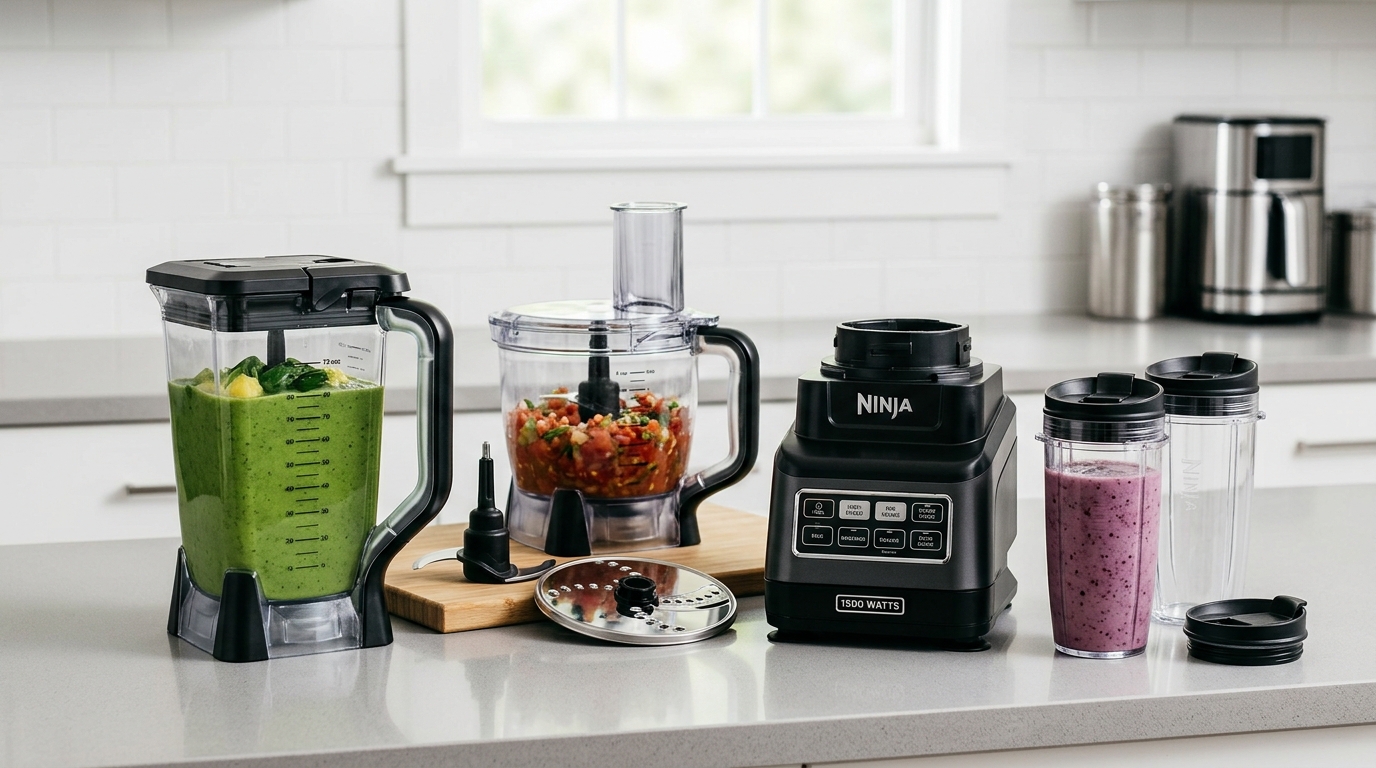
The Ninja Kitchen System BL770 is built around exactly this idea. Rather than a blender with a food processor attachment as an afterthought, or a food processor that technically blends but doesn’t do it well, the BL770 was designed from the ground up as a multi-component system where each included accessory is genuinely capable for its intended purpose. A full-size 72-ounce pitcher for batch blending. An 8-cup food processor bowl for chopping, mixing, and dough. Two 16-ounce to-go cups with lids for single-serve portable blending. All powered by a 1,500-watt motor base designed to handle the demands of all three configurations.
At 1,500 watts — 300 more than the Professional Blender 2.0 — the BL770 brings meaningful additional power to a system that needs to perform across more varied tasks than a dedicated blender or food processor alone. This article examines each component of the system in detail, how they work in real cooking situations, who benefits most from this approach to kitchen equipment, and what’s worth understanding before deciding whether the BL770 fits your kitchen and cooking habits.
What Is the Ninja Kitchen System BL770?
The BL770 is a multi-function kitchen system consisting of a 1,500-watt motor base and three distinct attachment configurations that transform the same power unit into three different kitchen tools. The full 72-ounce pitcher converts it into a full-size blender for large-batch blending. The 8-cup food processor bowl with blade and dough blade attachments converts it into a food processor for chopping, mixing, and dough making. The two 16-ounce to-go cups convert it into a personal single-serve blender for portable drinking containers.
The black exterior suits contemporary kitchen aesthetics and the system’s components store together as a coherent unit rather than as mismatched separate appliances from different brands taking up independent storage space.
Key Features of the Ninja BL770
1,500-Watt Motor Base
The motor base is the foundation of the entire BL770 system, and its 1,500 watts is the detail that enables genuine performance across three different attachment configurations rather than adequate performance in one and compromised performance in the others.
Understanding why additional wattage matters specifically for this system requires thinking about what each attachment demands from the motor:
The 72-ounce pitcher blending configuration needs sustained high-speed blade rotation through dense, frozen, and fibrous ingredients — the same demand that makes 1,200 watts a meaningful threshold for dedicated blenders. At 1,500 watts, the BL770 handles this with additional headroom above the minimum capability threshold.
The 8-cup food processor configuration needs torque — rotational force applied to the cutting blade through denser ingredients like root vegetables, hard cheeses, and raw dough. Food processing places different stress on a motor than liquid blending, and adequate wattage ensures the blade maintains consistent rotation speed through resistant materials rather than slowing when it encounters denser ingredients.
The 16-ounce to-go cup configuration needs to produce smooth results from frozen ingredients in a small-volume, direct-drive cup format — similar demands to a dedicated personal blender but drawing from the same 1,500-watt base.
A motor that underperforms in any one of these configurations compromises the value proposition of the entire system. The 1,500-watt base ensures performance is genuine across all three rather than optimized for one and merely acceptable for the others.
72-Ounce Full-Size Blender Pitcher
The 72-ounce pitcher attachment transforms the BL770 base into a full-size blender with the same capacity advantage that the Professional Blender 2.0’s pitcher provides — nine cups of blending volume that accommodates family-sized smoothie batches, large quantities of frozen drinks, blended soups for a dinner party, and similar high-volume blending tasks.
The pitcher uses Ninja’s stacked blade design — multiple blade tiers at different heights — producing the Total Crushing Technology processing approach that handles frozen fruit, ice, and fibrous ingredients more evenly throughout the pitcher volume than single-blade designs manage at comparable quantities.
For a household that blends daily for multiple people, the 72-ounce pitcher is the BL770 component that gets the most regular use — the morning smoothie batch, the weekend margaritas, the weeknight blended soup. Its performance in this configuration is directly comparable to a dedicated blender of equivalent wattage.
8-Cup Food Processor Bowl with Multiple Blades
The food processor bowl is where the BL770 genuinely expands beyond what a standard blender system offers. An 8-cup bowl with a processing blade and a separate dough blade gives the system genuine food processor capability — not approximate or compromised, but actual food processing for the tasks that food processors do best.
The processing blade handles chopping, slicing (with appropriate accessories), pureeing dense ingredients, making dips and spreads, and general food processing tasks. Salsa from fresh tomatoes, herbs, and aromatics. Hummus from chickpeas and tahini. Finely chopped onions for cooking. Grated cheese. Breadcrumbs from day-old bread. These are the food processor tasks that a blender handles poorly or not at all — food processor-specific techniques that require the different mechanical action of a horizontally rotating blade in a wide, shallow bowl rather than the vertical vortex of a pitcher blender.
The dough blade is the more specialized inclusion and reflects a specific design decision about what the BL770 system should be able to accomplish. Dough mixing requires the blade to incorporate flour and liquid while developing gluten structure through mechanical action — a task that food processor dough blades are specifically designed for. Pizza dough, bread dough, and pastry dough are all achievable in the 8-cup food processor bowl using the dough blade, producing mixed and developed dough in a fraction of the time hand mixing requires.
This dough-making capability is one of the more genuinely useful features of the BL770 for households that bake regularly — the combination of food processor speed and the dough blade’s specific design handles this task efficiently in a way that neither a standard blender nor a hand mixer can replicate.
Two 16-Ounce To-Go Cups with Lids
The two included 16-ounce to-go cups with lids give the BL770 personal blender capability in the same system. Each cup attaches directly to the motor base in the inverted orientation common to Ninja’s personal blender line — the blade assembly is part of the lid, which becomes the base when inverted on the motor, blending directly into the cup that then becomes the drinking container.
The to-go cup configuration is most useful for individual servings — morning smoothies for one person, post-workout protein shakes, single-serve frozen drinks — where the 72-ounce pitcher is disproportionate to the serving need. Blend directly in the cup, attach the drinking lid, and the serving container is ready without any transfer required.
Two cups in the package means two household members can each blend their own serving simultaneously or in quick succession without waiting for one cup to be washed before the other can be used. For couples or small households where each person has different smoothie preferences, this is a practical advantage over systems that include only one to-go cup.
Ninja Auto-iQ Programs
The BL770 includes Auto-iQ intelligent blending programs that execute predetermined sequences of speed levels and pulse patterns for specific blending tasks. These programs automate the technique management that produces optimal results from different ingredient types — the same capability that the Professional Blender 2.0 brings to dedicated blending, now available in a system that also handles food processing.
For the 72-ounce pitcher configuration, Auto-iQ programs cover smoothie making, ice crushing, and other common high-volume blending tasks. The programs run automatically when selected, producing consistent results without requiring the user to manage blend speed throughout the cycle.
Complete System Storage
The BL770’s components are designed to store together as a system — the base, pitcher, food processor bowl, and to-go cups all store in a cohesive configuration rather than as scattered separate pieces. For kitchens where storage organization is a genuine consideration, having all components of a multi-function system store together tidily is a practical advantage over owning separate individual appliances that don’t share any storage relationship.
How the Ninja BL770 System Can Be Used
Morning Smoothies at Different Scales
The BL770’s flexibility in serving size is one of its most practically useful daily characteristics. For a household where one person wants a single smoothie while others want different breakfasts, the 16-ounce to-go cup handles that individual serving efficiently without running a 72-ounce pitcher 25 percent full. For mornings when the whole family wants smoothies, the 72-ounce pitcher produces four servings in a single cycle.
This scale flexibility is something a dedicated blender can’t match — a 72-ounce pitcher used for a single serving is inefficient both in blending performance and in cleanup effort. The BL770’s cup attachment option makes single-serve blending proportionate to the task.
Fresh Salsa and Dips
Fresh salsa from raw ingredients — tomatoes, onions, jalapeños, cilantro, garlic, lime juice — is a natural food processor task that the BL770’s 8-cup bowl handles directly. The processing blade chops and combines the ingredients to the texture salsa requires — a coarse, chunky consistency that a pitcher blender would process too finely if used for the same task. The pulse control in the food processor configuration gives precise texture control at the moment the desired consistency is reached.
Guacamole, although typically mashed rather than processed, benefits from the food processor bowl for finely mincing the aromatics — onion, jalapeño, cilantro — before they’re combined with avocado manually. The food processor’s precision chopping produces more evenly minced aromatics than hand chopping in a fraction of the time.
Hummus — chickpeas, tahini, garlic, lemon juice, and olive oil — processes in the food processor bowl to the smooth, creamy consistency that pitcher blenders struggle with because the thick, low-liquid combination doesn’t form a proper blending vortex. The food processor’s blade action handles this dense combination effectively.
Pizza Dough and Bread Dough
The dough blade converts the 8-cup food processor bowl into a dough mixer for the quantities appropriate to a home baking session. Pizza dough for one or two pizzas, a small batch of dinner rolls, a loaf of sandwich bread — these quantities fit within the 8-cup bowl and process efficiently through the dough blade.
The food processor method for dough mixing is faster than hand kneading and produces well-developed gluten structure in a fraction of the time. The process is straightforward: dry ingredients go in first, wet ingredients are added gradually through the feed tube while the machine runs, and the dough comes together and is processed for the specified mixing time. The result is properly developed dough ready for shaping and proofing.
For households that make pizza regularly — particularly those who make their own dough rather than using store-bought — having this capability built into the same system that handles blending is a meaningful kitchen consolidation.
Frozen Cocktails for Groups
The 72-ounce pitcher and 1,500-watt motor handle frozen cocktail making at group scale. Margaritas, daiquiris, piña coladas, and frozen lemonade all require proper ice crushing and thorough ingredient blending — tasks the BL770’s pitcher configuration handles well. The 72-ounce capacity means making drinks for a group in a single or at most two cycles rather than running the blender repeatedly while hosting.
The motor’s additional wattage compared to lower-powered blenders is most apparent in ice-heavy frozen drink preparation, where maintaining blade speed through a pitcher full of ice and liquid requires sustained power output.
Shredding and Chopping Vegetables
The food processor bowl handles vegetable preparation tasks that are tedious by hand — grating carrots for salads or baking, shredding cabbage for coleslaw, roughly chopping large quantities of onions for a batch of soup or stew. What takes five minutes of hand prep takes thirty seconds in the food processor, and the consistency of the result is more uniform than hand-produced chopping.
For batch cooking sessions where large quantities of vegetables need preparation before cooking begins, the food processor bowl substantially reduces the active preparation time, which is particularly relevant for households that cook in volume on weekends for the week ahead.
Single-Serve Smoothies for the Work Bag
The to-go cup format is specifically designed for the scenario of blending a single smoothie and carrying it directly in the blending cup. Frozen fruit, spinach, yogurt, and milk or a milk alternative blend directly in the 16-ounce cup, the drinking lid attaches, and the finished smoothie is carried in the same container it was blended in — no transfer, no second container, no additional cleanup.
For working adults who prepare breakfast the morning before leaving the house and consume it during a commute or at a desk, this workflow efficiency is genuinely practical in a way that requires the specific design of the to-go cup attachment rather than simply using a regular blender and pouring into a travel container.
Who the Ninja BL770 System May Be Suitable For
Households Wanting to Reduce Appliance Count
The most direct and compelling audience for the BL770 is households that currently own a separate blender and food processor — or who have been putting off buying one because they don’t want another appliance taking up space — and want the capability of both in a single system. Replacing two separate appliances with one integrated system frees both counter and cabinet space while maintaining genuine capability in both categories.
Regular Home Bakers
The dough blade’s inclusion specifically targets households that bake bread, pizza, or pastry regularly. For anyone making dough by hand currently and dealing with the time and effort that hand kneading requires, the food processor dough blade is a direct and meaningful upgrade in the workflow — the same result in substantially less time and physical effort.
Mixed Household Serving Needs
Households where different people need different serving sizes — one person wanting a single smoothie while others want a full batch, or a household that serves one-person breakfast on weekdays and family breakfasts on weekends — benefit from the BL770’s scale flexibility. The same system handles both scenarios through different attachment configurations.
Households That Cook Fresh Ingredient-Forward Food
For cooking styles that rely heavily on fresh ingredients processed at home — fresh salsas, homemade dips, freshly chopped aromatics, grated cheese for cooking rather than pre-grated — the food processor bowl provides the equipment that makes these preparations practical on a weeknight cooking schedule rather than time-consuming enough to default to store-bought alternatives.
People Setting Up a First Kitchen
For someone equipping a kitchen from scratch — a first apartment, a new household, a kitchen being rebuilt after a move — the BL770 provides blending and food processing capability in a single purchase rather than requiring two separate appliances. The total investment is typically less than equivalent-quality dedicated blender and food processor purchased separately, and the unified system approach means less total storage space required.
Important Things to Consider
The System Has More Components to Manage
Three distinct attachment configurations mean more physical components to store, clean, and track than a single dedicated appliance. The pitcher, food processor bowl, dough blade, processing blade, two cups, and their respective lids represent more pieces than either a standalone blender or standalone food processor. Households that find appliance complexity frustrating may prefer the simpler ownership experience of two separate dedicated appliances over one integrated system with more components.
Food Processor Bowl is 8-Cup, Not Full-Size
Eight cups is a practical food processor capacity for everyday home cooking tasks, but it’s smaller than full-size food processors that accommodate 11 to 14 cups. For households that regularly process very large quantities — making large batches of pastry dough, processing multiple pounds of vegetables at once — the 8-cup capacity may require multiple processing rounds for the largest tasks. For most everyday household cooking quantities, 8 cups is more than adequate.
The Pitcher and Cups Require Liquid for Blending
Like all blenders, the pitcher and to-go cup configurations require adequate liquid to form the vortex that produces proper blending. Very thick combinations with minimal liquid don’t blend effectively in any blender configuration. This is a fundamental characteristic of blender physics rather than a specific BL770 limitation, but it’s worth understanding clearly for managing expectations around thick smoothie bowl preparations and similar low-liquid applications.
Dough Capacity Has Limits
The 8-cup food processor bowl handles home baking quantities of dough appropriately — one to two pizza dough batches, a small bread loaf, a batch of dinner rolls. For very large dough batches — multiple loaves, large-scale baking sessions — the capacity may require working in multiple batches. For typical home baking volumes, the capacity is appropriate.
Cleaning Multiple Configurations
Using the BL770 across multiple configurations in a single day means cleaning multiple components. Using the pitcher for a morning smoothie and the food processor bowl for afternoon prep creates two sets of components to clean rather than one. For households that find multi-component cleanup burdensome, this is worth factoring into the practical ownership experience.
How the Ninja BL770 Compares to Other Options
BL770 vs. Ninja Professional Blender 2.0
The most direct Ninja-internal comparison is between the BL770 system and the dedicated Professional Blender 2.0 blender. The Professional Blender 2.0 is a pure blending appliance — one pitcher, one function, optimized for blending. The BL770 adds food processing and personal blender capability through the food processor bowl and to-go cups, at the cost of more components and a higher price point.
For households whose primary need is batch blending and who rarely need food processing capability, the Professional Blender 2.0 is the more focused and typically less expensive choice. For those who want both blending and food processing from one system, the BL770’s addition of the food processor bowl changes the value calculation meaningfully.
BL770 vs. Buying a Separate Blender and Food Processor
The primary alternative to the BL770 is purchasing a dedicated blender and a dedicated food processor separately. Separate appliances offer the advantage of each being optimized for its specific function — the best dedicated blender produces marginally better blending results than a blending component of a multi-system at comparable price points, and the best dedicated food processor similarly. The disadvantages are greater total cost, more total storage space required, and more equipment to maintain.
For households where maximum performance in each category is the priority, separate dedicated appliances from premium brands make the case. For those prioritizing cost efficiency, storage consolidation, and genuine-enough performance across both categories, the BL770’s integrated approach is compelling.
BL770 vs. Vitamix All-in-One Systems
Vitamix produces blender-food processor combination systems at price points significantly above the BL770. These systems use Vitamix’s commercial-grade motor and proprietary processing accessories to deliver performance that genuinely exceeds what the BL770 achieves in both blending and processing. For households that prioritize maximum performance and have the budget for premium equipment, Vitamix combination systems are worth the comparison. For those whose performance needs are well served by the BL770’s capability level, the price premium of Vitamix is difficult to justify.
BL770 vs. Standard Countertop Blenders Without Food Processing
Against standard countertop blenders that lack food processing capability — essentially comparing the BL770 to just its pitcher configuration at a lower price — the BL770’s food processor bowl is the differentiating value. Whether that value is worth the price difference between a capable dedicated blender and the BL770 system depends entirely on how regularly food processing tasks appear in the household’s cooking routine. For households that frequently need chopping, shredding, and dough mixing, the food processor bowl is a meaningful daily-use addition. For those whose cooking rarely involves these tasks, a dedicated blender covers the realistic need at lower cost.
Frequently Asked Questions
Can I use the 72-ounce pitcher to make hot soup directly, or does the soup need to be cooled first?
Hot soup can be blended in the 72-ounce pitcher with appropriate precautions — filling no more than halfway, starting at low speed, holding the lid firmly with a folded kitchen towel, and building speed gradually. Steam pressure from hot liquid in a sealed blender creates safety risks if the lid isn’t managed carefully. Never fill the pitcher more than halfway with hot liquid and never start at high speed with hot contents. Following these precautions makes hot soup blending safe and effective.
How much pizza dough can the 8-cup food processor bowl make in a single batch?
The 8-cup bowl handles dough quantities appropriate for one to two standard pizza rounds — roughly enough dough for two medium-sized pizzas. For households making pizza for four to six people from scratch in a single session, this capacity covers that typical home pizza-making scenario comfortably. Very large batches for more pizzas may require two processing rounds.
Does the food processor bowl’s processing blade handle hard cheeses like Parmesan?
Hard cheeses process better when very cold — chilled or partially frozen Parmesan shreds and processes more cleanly than room-temperature Parmesan, which tends toward clumping. Cut into smaller chunks before processing rather than adding a large piece. The processing blade handles this effectively with properly cold cheese, producing results comparable to pre-grated hard cheese from the store.
Are the to-go cups the same as those included with dedicated Ninja personal blenders?
The to-go cups included with the BL770 are compatible with the same motor base and follow the same inverted blending design as Ninja’s personal blender cups. The 16-ounce size is standard for Ninja’s single-serve format. In some cases, compatible cups from Ninja’s personal blender line may be interchangeable with the BL770 base, though compatibility should be confirmed through Ninja’s current accessory documentation.
How does cleanup work for the food processor bowl compared to a dedicated food processor?
The food processor bowl and its blades require the same cleaning care as any food processor — washing the bowl and blades with warm soapy water after use, being careful around sharp blade edges during cleaning. The bowl is typically top-rack dishwasher safe, though hand washing the blade assemblies is generally recommended to maintain edge sharpness over time. The cleaning process is comparable to a dedicated food processor of similar size.
Can the BL770 make almond milk or other nut milks?
Yes, using the 72-ounce pitcher. Soaked almonds, cashews, or oats blended with water process to fine consistency in the pitcher, which is then strained through a nut milk bag to separate the milk from the remaining pulp. The 1,500-watt motor produces finely processed nut milk that strains more cleanly than lower-powered blenders, yielding more usable milk per batch with less remaining pulp.
Is the Auto-iQ available in the food processor bowl configuration?
Auto-iQ programs are designed for the blender configurations — the 72-ounce pitcher and the to-go cups — rather than the food processor bowl. Food processing is managed through manual speed control and the pulse function, which provides the direct control that food processing tasks require — stopping precisely when the desired texture is reached rather than running a predetermined time sequence.
What’s the total counter footprint of the BL770 system when assembled?
The motor base with the 72-ounce pitcher attached is the largest assembled configuration. The food processor bowl and to-go cups represent smaller footprints when attached to the same base. The system components that aren’t in use need storage space — the included pitcher, bowl, blades, cups, and lids all require dedicated storage. Measuring available counter space for the base and planning storage for non-active components before purchasing helps establish realistic expectations about how the system fits into a specific kitchen.
Conclusion
The Ninja Kitchen System BL770 makes its case through genuine multi-function capability rather than the half-measures that describe many combination appliances. The 72-ounce pitcher produces real batch blending performance at 1,500 watts — not a compromised blender in a multi-function body, but actual blending capability comparable to a dedicated machine at this power level. The 8-cup food processor bowl with processing and dough blades handles actual food processor tasks — not approximate versions of chopping and dough making, but the genuine food processor functionality those tasks require. The 16-ounce to-go cups provide actual personal blender convenience for single-serve portable use.
This genuine capability across three distinct functions is what justifies the system approach over owning separate dedicated appliances. A blender that happens to have a food processor attachment that doesn’t work very well doesn’t consolidate equipment — it just adds an underperforming attachment. The BL770’s food processor bowl works well enough to replace a dedicated food processor for most household cooking needs, and that’s the standard that determines whether the system approach delivers its promised value.
The trade-offs — more components to manage and clean, an 8-cup food processor capacity that’s smaller than full-size dedicated models, the inherent complexity of a multi-component system — are genuine and worth factoring into the decision. For households whose cooking regularly involves both blending and food processing, and who want to address both needs from one system rather than two separate appliances competing for counter and cabinet space, the BL770 offers a well-engineered and genuinely capable solution.