Introduction
Frozen drinks occupy a specific and well-loved place in the food and beverage landscape. A properly made slushie — smooth, icy, consistently cold throughout — is one of those simple pleasures that’s genuinely difficult to replicate at home with standard kitchen equipment. Blenders produce inconsistent textures that separate quickly. Ice crushers create uneven chunks rather than the fine, uniform ice crystals that define a proper slush. And the convenience store slushie machine — the real thing, with its constantly churning frozen drink — has always been the gold standard that home setups couldn’t meaningfully approach.
The Ninja Slushi changes that calculation. Rather than working with pre-made ice or relying on a blender to approximate slush texture, it uses Rapid Chill Technology to freeze the beverage itself as it churns — the same fundamental approach that commercial slushie machines use, scaled for home kitchen countertop use. The 88-ounce vessel handles quantities appropriate for gatherings and entertaining. Five preset programs cover different frozen drink styles from standard slushies to frozen coffee drinks to spiked cocktail slushes. And the no-ice-required approach means the flavor isn’t diluted by melting ice cubes — the drink itself freezes, maintaining full flavor concentration throughout.
This article examines what the Ninja Slushi actually delivers in practice, how its technology works across different beverage types, who it genuinely serves, and what’s worth knowing before deciding whether it earns a place in your kitchen or entertaining setup.
What Is the Ninja Slushi?
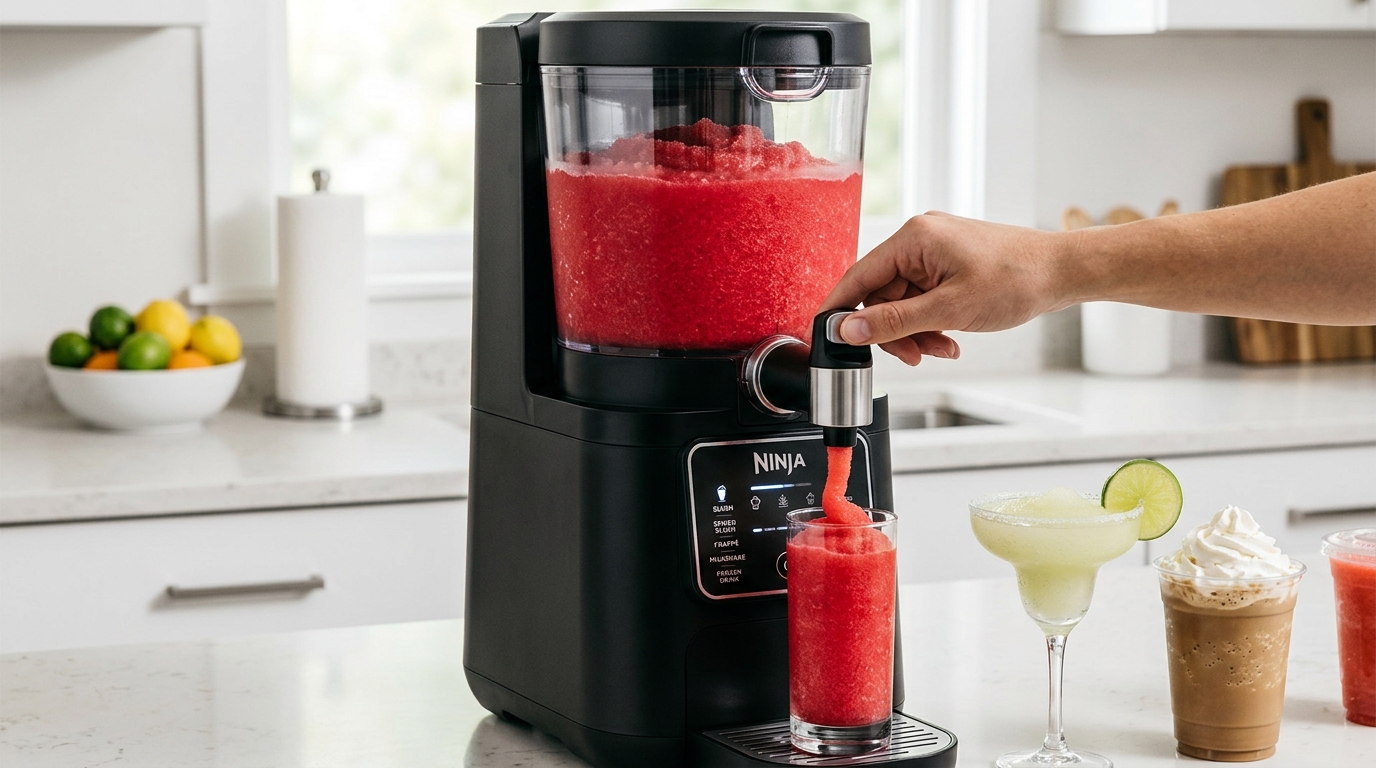
The Ninja Slushi is a dedicated frozen drink machine — not a blender, not an ice crusher, but a purpose-built appliance that uses refrigeration technology to chill and freeze beverages as they’re continuously stirred, producing the smooth, fine-crystal slush texture characteristic of commercial frozen drink machines.
The distinction from blender-based frozen drink preparation is fundamental. A blender works with pre-frozen ice and blends it into a beverage. The Ninja Slushi contains its own chilling mechanism that actively reduces the temperature of the liquid in the vessel while stirring it, creating ice crystals directly within the beverage itself. This approach — the same principle behind commercial slushie machines — produces a fundamentally different texture outcome and eliminates the ice-to-liquid dilution that makes blended frozen drinks progressively weaker as the session continues.
The 88-ounce vessel is sized for entertaining rather than individual servings. The anti-drip spout makes dispensing clean and practical. And the dishwasher-safe parts address one of the more relevant maintenance considerations for a machine used for sticky, sugary, or alcohol-containing beverages.
Key Features of the Ninja Slushi
Rapid Chill Technology: How It Actually Works
The technology distinction is the most important thing to understand about the Ninja Slushi, because it determines everything about the texture, flavor, and practical experience of what the machine produces.
Conventional frozen drink preparation relies on pre-frozen ice — either ice cubes crushed or blended into a beverage, or a blender working with frozen fruit and ice to produce something that approximates slush. The fundamental limitation of this approach is that ice is water, and water dilutes whatever it’s mixed into as it melts. The initial serving from a blended frozen drink may taste appropriately strong, but the drink progressively weakens as the ice melts over the following minutes. For a gathering where the machine sits on a table and people serve themselves over an hour, blended drinks become noticeably weaker and more watery toward the end of the batch.
Rapid Chill Technology avoids this entirely. The Ninja Slushi’s refrigeration system actively chills the liquid in the vessel while the stirring mechanism continuously agitates it. As the temperature drops below freezing, small ice crystals form throughout the liquid itself — not added ice, but the beverage’s own water content partially crystallizing while the flavor compounds remain in the increasingly concentrated unfrozen portion.
This is the same basic chemistry that makes commercial slushie machines work, and it produces the same result: a slush where the flavor concentration remains consistent throughout the batch because no external water is being added and diluting it. The last serving from a Ninja Slushi batch tastes the same as the first serving.
The “Rapid” aspect of Rapid Chill Technology refers to the speed at which the machine reaches proper slush consistency from a room-temperature beverage — Ninja has engineered the chilling and agitation system to reach target slush temperature faster than the time it takes a typical consumer machine to freeze a beverage adequately.
88-Ounce Easy Fill Vessel
Eighty-eight ounces — approximately 11 cups or 2.75 quarts — positions the Ninja Slushi firmly in the entertaining appliance category rather than the personal single-serve category. This is a meaningful volume that produces enough frozen drink for eight to twelve people at a gathering depending on serving size, or enough for a family to enjoy over an extended afternoon without needing to reload the machine.
The “easy fill” designation refers to the vessel’s design, which allows beverages to be poured in conveniently without requiring a funnel or creating spill risks from a narrow opening. For practical entertaining use — filling the machine with a pre-mixed cocktail batch, a gallon of lemonade, or a large quantity of juice — the filling process needs to be clean and straightforward.
Anti-Drip Spout
The anti-drip spout is a detail that becomes increasingly important the more the machine is used in an entertaining context. Slushie machines used at parties or gatherings get heavy use — multiple people dispensing their own servings throughout an event. A spout that drips between uses creates sticky messes on the machine exterior and the surface beneath it, which compounds through an evening into a significant cleanup situation.
The anti-drip design cuts off cleanly when released, keeping the machine and surrounding area cleaner through sustained use. For home entertaining where the Ninja Slushi sits on a counter or table while guests help themselves, this is the kind of practical detail that distinguishes a well-designed appliance from a frustrating one.
Five Preset Programs
The five preset programs cover different frozen drink categories, each calibrated for the specific characteristics of that beverage type and the texture outcome appropriate for it:
Slush is the foundational program — the standard frozen slushie texture that the machine’s name reflects. Fine, uniform ice crystals suspended throughout the beverage, properly slushy consistency that flows through the spout smoothly, consistent texture from first serving to last. This program suits standard slushie beverages — fruit juices, flavored drinks, lemonade, sports drinks — producing the familiar slushie experience that convenience store machines produce.
Spiked Slush is specifically calibrated for alcoholic beverages. Alcohol has a lower freezing point than water — ethanol freezes at -114°C, well below what any home appliance reaches — which means alcoholic beverages require different chilling parameters to reach proper slush consistency than non-alcoholic ones. A standard slushie setting applied to an alcoholic drink would produce a result that’s too liquid because the alcohol prevents adequate freezing. The Spiked Slush program adjusts the chilling and agitation approach for beverages with alcohol content, producing a properly slushy cocktail rather than a cold but insufficiently frozen drink. This dedicated program is one of the more thoughtful inclusions in the Ninja Slushi’s feature set — without it, making cocktail slushies would require significant trial and error to achieve appropriate consistency.
Frappé targets frozen coffee drink preparation — the cold blended coffee beverages that coffee shops have made extremely popular and that home preparation has historically approximated rather than matched. The Frappé program’s calibration suits coffee-based beverages with milk or cream content, producing a frozen coffee drink texture closer to the professional coffee shop version than a blender approximation achieves.
Granita produces a coarser, icier frozen dessert texture than the smooth slush — the Italian-style crushed ice dessert that maintains distinct ice crystal character rather than processing to smoothness. Granitas are typically made from fruit juice, coffee, or wine, and their defining texture characteristic is that grainier, more crystalline consistency that differentiates them from smooth slush. This program suits wine granitas, coffee granitas, citrus granitas, and similar preparations.
Smoothie incorporates the vessel’s chilling capability into a smoothie-adjacent frozen drink preparation, producing a thicker, more substantial frozen drink than the standard Slush program. This program works with fruit-based beverages that benefit from a smoother texture than a granita but more body than a standard slush.
No Ice Needed
The “no ice needed” aspect is more than a convenience claim — it’s the practical consequence of Rapid Chill Technology that has direct implications for flavor, planning, and entertaining experience.
From a flavor standpoint, no ice means no dilution. The strength and flavor profile of whatever goes into the vessel is the strength and flavor profile of what comes out — not a progressively weakening version of it as ice melts.
From a planning standpoint, no ice means no ice run before the party, no ensuring the ice maker has kept up with demand, and no dealing with a partially melted bag of ice that went in lukewarm drinks. The preparation simplifies to: pour the beverage into the vessel, select the program, and wait for the machine to reach slush consistency.
For gatherings, this combination of full-strength flavor and simplified preparation changes the practical experience of offering frozen drinks to guests.
Dishwasher-Safe Parts
The dishwasher-safe designation for the machine’s removable components addresses the practical reality of what goes into a Ninja Slushi across its use cases. Sugary slushie drinks, alcohol-containing cocktail slushes, coffee-based frappé preparations, and fruit-based granitas all leave residue that can be sticky, staining, or odor-absorbing if not thoroughly cleaned. The ability to put components through a dishwasher rather than hand-scrubbing all surfaces is a meaningful convenience for post-party cleanup or regular use maintenance.
How the Ninja Slushi Can Be Used
Classic Fruit Slushies for Family and Gatherings
The most straightforward application is the classic fruit slushie — fruit juice, flavored drink, or homemade fruit-and-sugar mixture poured into the vessel and processed through the Slush program. The machine handles the rest, producing a consistent, properly textured slush over the chilling period.
For family gatherings, summer parties, children’s events, or any occasion where a refreshing cold drink in large quantity is wanted, the 88-ounce capacity means filling the vessel once and dispensing throughout the event without reloading. Kids help themselves from the spout, adults refill their cups, and the machine maintains slush consistency throughout.
The flavor flexibility is significant — any beverage with appropriate sugar content (which facilitates slush formation) can go through the Slush program. Lemonade, cherry drink, watermelon juice, tropical blends, sports drinks, iced tea — the range of what becomes a slushie in the Ninja Slushi is limited primarily by imagination rather than the machine’s parameters.
Cocktail Slushies for Adult Entertaining
The Spiked Slush program positions the Ninja Slushi as a serious entertaining tool for adult gatherings. Frozen margaritas, spiked lemonade slush, rosé slushies, sangria slush, frozen palomas — cocktail slushies have become a popular party offering that previously required either a commercial machine or significant blending effort.
The Spiked Slush program’s calibration for alcohol-containing beverages means proper slush consistency is achievable for a wide range of spirit-based mixed drinks rather than requiring precise alcohol percentage calculations to work around the lowered freezing point.
For hosts who regularly entertain, having a machine that can be loaded with a pre-mixed batch cocktail at the start of an evening and dispense consistently throughout the party changes the hosting experience — guests serve themselves, the flavor stays consistent, and the host isn’t repeatedly making individual blended drinks.
Frozen Coffee Drinks at Home
Coffee shop frozen blended coffee drinks — frappuccinos, cold brew frappes, blended iced coffee — represent a significant ongoing expense for coffee drinkers who consume them regularly. The Frappé program on the Ninja Slushi offers a home production approach that, while not identical to the specific preparations of any particular coffee chain, produces frozen coffee drinks in the same general category.
A base of cold brew coffee, espresso, or strong brewed and cooled coffee combined with milk or cream and a sweetener — processed through the Frappé program — produces a frozen coffee drink with genuine similarity to commercial versions. For households that regularly spend on specialty frozen coffee, the cost comparison over time favors the home appliance substantially.
Wine and Fruit Granitas
The Granita program targets an entirely different frozen drink category than slush — the Italian-origin frozen dessert that maintains a deliberately grainy, crystalline ice texture rather than being processed to smoothness. Wine granitas — rosé, prosecco, red wine — are a sophisticated entertaining offering that require the specific texture the Granita program produces rather than the smoother outcome of the Slush program.
Coffee granitas — a Sicilian classic — combine strong coffee with sugar, frozen and scraped to the characteristic granita texture. Citrus granitas from fresh lemon or grapefruit juice. The Granita program produces these with appropriate texture that distinguishes them from slushies or smoothies.
Batch Preparation for Large Events
The 88-ounce capacity particularly suits batch preparation scenarios — making enough frozen drink for a significant number of guests in a single vessel load. Pre-mixing large quantities of a chosen beverage, pouring into the vessel, and processing provides self-service frozen drink capability throughout an event without requiring the host to manage individual servings.
The anti-drip spout makes guest self-service practical — guests can dispense their own servings cleanly without creating the drip mess that other dispensing systems produce.
Who the Ninja Slushi May Be Suitable For
Regular Home Entertainers
Households that host gatherings regularly — summer barbecues, holiday parties, game day events, casual get-togethers — represent the strongest fit for the Ninja Slushi’s 88-ounce capacity and self-service design. The machine’s value is most apparent when a group of people is serving themselves over an extended period, and its flavor-preservation advantage over blended frozen drinks becomes most relevant over the course of a multi-hour event.
Families With Children During Summer
For households with children where frozen drinks are a regular summer fixture, the Ninja Slushi provides a home version of the convenience store slushie experience. Loading the machine with fruit juice or a flavored drink and having slushies available on demand throughout a summer afternoon is a practical and crowd-pleasing application.
Cocktail and Frozen Drink Enthusiasts
Adults who specifically enjoy frozen cocktails — margaritas, daiquiris, sangria slushies — and either pay for them regularly at bars and restaurants or want to serve them at home have a specific need that the Ninja Slushi addresses more directly than any other home appliance. The Spiked Slush program’s specific calibration for alcoholic beverages makes this a genuine solution rather than an approximation.
Coffee Shop Frequent Visitors
For people who regularly spend on specialty frozen coffee drinks, the Frappé program provides a home production alternative. The savings calculation over months of regular frozen coffee consumption versus the appliance investment is favorable for consistent users.
Households That Host Outdoor Events
The anti-drip spout and self-service design suit outdoor entertaining scenarios where the machine can be set up on a table and guests help themselves throughout an event. The 88-ounce capacity handles a significant number of servings before requiring attention, which suits the lower-supervision requirements of outdoor casual entertaining.
Important Things to Consider
Chilling Time Before Serving
Unlike a blender that produces a frozen drink in 60 seconds, the Ninja Slushi requires time to chill the beverage to slush consistency through the refrigeration and agitation process. The preparation window before guests arrive or before serving needs to accommodate this chilling period — beverages should be started well ahead of when they’re needed. The “Rapid” in Rapid Chill Technology refers to a faster-than-standard chilling process, but it still requires meaningful lead time compared to blender-based preparation. Planning the preparation window appropriately is essential to the machine delivering ready slush when it’s needed.
Not Designed for Individual Servings
The 88-ounce vessel is sized for groups. Making a single personal slushie involves filling a vessel designed for a gathering, running the machine to chill a large volume for one serving, and dealing with leftover slush. For individual daily slushie making, the scale mismatch between machine and use makes it impractical. The Ninja Slushi is a gathering appliance — its capacity, design, and use case all reflect group serving rather than individual portions.
Sugar Content Affects Slush Formation
The refrigeration-based slush formation process depends on the presence of sugar (or other solutes) in the beverage to function correctly. Pure water freezes solid at 0°C, but solutions with dissolved solids freeze at lower temperatures, which is what creates the partially frozen slush state. Beverages with insufficient sugar content may freeze too solidly in the vessel rather than remaining in proper slush consistency. Most commercial beverages, juices, and prepared mixes have adequate sugar content, but very low-sugar or sugar-free beverages may require adjustment to achieve appropriate slush texture.
Alcohol Percentage Affects Results in Spiked Slush
While the Spiked Slush program is calibrated for alcoholic beverages, very high-proof spirits added in large quantities lower the freezing point of the mixture significantly, potentially preventing adequate slush formation. Beverages with moderate alcohol content — standard mixed drink strength rather than undiluted spirits — work best through the Spiked Slush program. Cocktail recipes designed for slushie machines rather than direct spirit-to-mixer ratios produce the best results.
Counter Space for a Dedicated Machine
The Ninja Slushi is a dedicated appliance with its own counter footprint — not a blender that also makes slushies, but a purpose-built machine. For kitchens where counter space is already contested and the appliance would only be used occasionally, the space commitment relative to usage frequency is worth assessing honestly. For households that entertain regularly or use frozen drinks frequently enough to justify dedicated machine space, the footprint is appropriate to the value delivered.
How the Ninja Slushi Compares to Other Options
Ninja Slushi vs. Blender-Based Frozen Drinks
The blender approach to frozen drinks — blending ice cubes and liquid, or blending frozen fruit into a drink — is the most common home alternative and the most direct comparison. The fundamental difference is the dilution question: blended drinks with ice weaken as the ice melts, the Ninja Slushi’s freeze-from-within approach maintains flavor concentration. Additionally, the 88-ounce capacity and self-dispensing spout make the Slushi more practical for group serving than a blender, which requires filling individual glasses and doesn’t maintain consistency if the blended batch sits waiting. For individual quick frozen drinks where one serving is the goal, a blender is faster. For group entertaining over time, the Slushi’s approach produces a better sustained result.
Ninja Slushi vs. Commercial Slushie Machines
Commercial slushie machines use the same freeze-while-stirring principle as the Ninja Slushi, scaled for much higher volume and continuous commercial operation. The Ninja Slushi is a consumer-grade version of this same technology — same principle, different scale, consumer price point. Commercial machines produce larger volumes continuously. The Ninja Slushi produces one 88-ounce batch at a time with a reloading period between batches. For home entertaining rather than commercial operation, the Ninja Slushi’s capacity and price point are appropriately scaled.
Ninja Slushi vs. Ice Cream Makers and Ninja CREAMi
The Ninja CREAMi and traditional ice cream makers produce frozen dessert textures — solid, scoopable, more fully frozen outcomes. The Ninja Slushi produces drinkable frozen beverages — slushy, pourable through a spout, consumed as drinks rather than desserts. They address different consumption formats. Some overlap exists in the granita and frozen dessert territory, but the core use cases are distinct: CREAMi for ice cream and frozen desserts, Slushi for drinkable frozen beverages.
Ninja Slushi vs. Manual Granita Making
Traditional granita preparation involves freezing a liquid mixture in a flat pan and scraping it periodically with a fork during the freezing process to create the characteristic crystalline texture. This method produces excellent results but requires active attention — returning to the freezer every 30 minutes to scrape, over a total of two to three hours. The Ninja Slushi’s Granita program handles this process automatically in the vessel with appropriate texture outcomes. For occasional granita making, the manual method requires no equipment investment. For those who want granita available more conveniently and regularly, the Slushi’s Granita program provides the outcome without the active process involvement.
Frequently Asked Questions
How long does it take for the Ninja Slushi to produce slush from a room-temperature beverage?
The preparation time varies based on the starting temperature of the beverage and the program selected, but Ninja’s Rapid Chill Technology is designed to reach proper slush consistency faster than standard home freezing methods. Starting with a refrigerator-cold beverage rather than room temperature significantly reduces preparation time. Consulting the specific program timing guidance in the product documentation provides the most accurate expectation for preparation windows.
Can I use the Ninja Slushi for hot beverages turned cold?
The machine is designed for beverages that are already cold or at room temperature — it’s a chilling and freezing appliance, not a cooling appliance for hot liquids. Adding hot beverages to the vessel would require the machine to work against the heat rather than cooling from an already-cold starting point, extending preparation time significantly and potentially affecting the machine’s chilling efficiency. Starting with already-cooled beverages produces the intended results.
How do I know when the slush is ready?
The preset programs are calibrated to reach target consistency within their run time, and the machine typically indicates program completion. Checking the consistency through the spout — dispensing a small amount to assess texture — is the most reliable way to confirm readiness before serving to guests.
Can I add fruit pieces or other solid ingredients to the vessel?
The Ninja Slushi is designed for liquid beverages rather than preparations with significant solid content. Small amounts of finely blended fruit in a juice or smoothie base can work through the vessel, but large solid pieces may interfere with the stirring mechanism. The vessel is optimized for liquid or near-liquid beverage bases rather than smoothie-style preparations with significant solid fruit content.
How does cleaning work after a session with alcoholic beverages?
The dishwasher-safe designation covers the removable parts, making post-use cleanup straightforward regardless of what type of beverage was used. Running the removable components through the dishwasher after use is the recommended cleaning approach. The machine’s interior surfaces and spout mechanism benefit from thorough rinsing to prevent residue buildup from sugary or alcohol-containing beverages.
Can I make the slush ahead of time and store it?
The slush in the vessel maintains its consistency as long as the machine is running. Once the machine is turned off, the slush will continue to freeze in the vessel — eventually becoming too solid to dispense through the spout. For immediate serving situations, the machine runs during the event. For preparation ahead of time, the beverage can be pre-mixed and stored in the refrigerator until close to serving time, then processed through the machine to reach slush consistency.
Does the Spiked Slush program work with wine and beer?
Wine-based beverages work well through the Spiked Slush program — wine has alcohol content in a range that the program is calibrated for. Beer presents more challenges due to carbonation, which behaves differently during the chilling and agitation process than non-carbonated alcoholic beverages. Flat beer or beer-based beverages where carbonation isn’t a priority may work through the program, but the carbonation interaction with the chilling process can produce unpredictable results with fresh carbonated beer. Starting with non-carbonated alcoholic beverages or wine for the Spiked Slush program produces the most reliable outcomes.
What’s the difference between the Slush and Smoothie programs?
The Slush program produces a lighter, icier, more liquid frozen drink texture — the classic slushie consistency. The Smoothie program produces a thicker, denser, more body-forward frozen drink that’s closer to a blended frozen beverage than a standard slush. The distinction between them is primarily in texture and viscosity — both are cold and frozen in character, but the smoothie program’s outcome is heavier and more substantial than the slush program’s outcome.
Conclusion
The Ninja Slushi Frozen Drink and Slushie Machine occupies a category that home kitchens have lacked a proper solution for — not a blender making approximate frozen drinks that weaken as the ice melts, not a manual process that requires constant attention, but a dedicated machine using the same freeze-while-stirring principle that commercial slushie machines use, scaled for home entertaining.
Its strengths are most apparent in the context it’s designed for: group entertaining where the 88-ounce capacity serves multiple people over extended time, the anti-drip spout enables clean self-service, and Rapid Chill Technology maintains consistent flavor and texture from the first serving to the last without the progressive dilution that ice-based alternatives produce. The Spiked Slush program’s specific calibration for alcoholic beverages adds genuine functionality for adult entertaining that would otherwise require significant experimentation to achieve.
The honest limitations are equally worth knowing: the chilling time requirement means planning ahead rather than making slushies spontaneously, the 88-ounce capacity is a gathering scale rather than a personal scale, and sugar content in the beverage affects slush formation in ways that pure water or very low-sugar drinks can’t overcome through the freeze-from-within process.
For households that entertain regularly, families where frozen drinks are a summer staple, adults who enjoy cocktail slushies, and anyone who has found the blender approach to frozen drinks consistently disappointing in texture and flavor maintenance over time, the Ninja Slushi provides the closest home equivalent to the commercial slushie machine experience currently available for consumer kitchens.